


Grabbing a mug from a high shelf, scooping a kid off the floor, twisting to snag a bag from the back seat of the car — these reaching actions are largely automatic. We do them without a second thought to proper form or care. That is until there’s a sudden twinge, spasm, or other sharp reminder that something we never had to think about can no longer be ignored.
As a veteran strength coach and rehabilitation specialist, I’ve worked with many clients who have suddenly had to contend with a loss of reach because of an injury.
Yet just as often, the ability to reach is diminished not by acute trauma but by neglect. As the adage goes, Use it or lose it.
How far your joints can open and stabilize is not fixed. Use them regularly and their range stays accessible and may even expand. Ignore them long enough and their range can quietly retreat.
Movement patterns that go unexplored may start to feel unfamiliar, then effortful, then risky. What once was the middle of your range of motion becomes the edge. What once was the edge may disappear entirely. Then, when you finally need to reach using a move you’re unaccustomed to, your body responds with alarm when it used to just respond.
These edges can be reclaimed. The body is remarkably responsive to exploration at any age. But reclaiming them requires practicing the very thing we stopped doing — reaching. Deliberately, consistently, a little farther than you’re comfortable with.
Worth the Reach
A reach is, at its core, an act of curiosity — the body asking How far can I go? What’s out there at the edge of what I can touch, grasp, or change? Every time you extend toward something beyond your grasp, you’re exploring a boundary. Maybe that’s a little poetic, but it’s also mechanically accurate.
From the outside, a good reach is easy to see. There’s length in the body: Space visibly opens from the base of the spine through the extended arm. The spine elongates rather than compresses. There’s a discernable line of tension from foot to fingertip, but the body isn’t rigid. And there’s a quality of intention — a sense that the reacher is genuinely moving toward something rather than just lifting a limb.
From the inside, a good reach feels like it starts farther back than you’d expect. It comes not from the hand, or even the shoulder, but from somewhere deep in the back and hips along the spine. You feel your shoulder blade glide away from your spine. You feel your core working as a bridge rather than a brace.
With practice, you’ll notice something counterintuitive when you reach: Your balance improves the farther you extend. That’s the nervous system registering that the reach is connected all the way down. This makes it easier to respond to surprises like ice, uneven ground, or a sudden turn in a game of tag.
A poor reach feels heavy and disconnected, effortful at the extremes, and slightly precarious. That’s the version that occasionally surprises you with a twinge.
The connected version, the one that travels from the ground up, is what you’re training toward.
An Exploration of Edges
The following five movements are designed to train your reach from the ground up. Practice them throughout your day, or as part of your warm-up before working out. When you do them is less important than doing them consistently. Pick at least one to practice each day.
With all five movements, your goal is to find your edge, breathe, and get your toes as far from your fingers as possible. Each one will tempt you into doing three things that immediately shrink your range: hold your breath, stop looking where you’re going, and arch your lower back to create a sense of safety. Notice when any of those happen. They’re signals that you’ve reached the edge of what your nervous system currently trusts, though not necessarily the edge of what your body can do. Back off slightly, breathe, and extend again slowly.
1. Overhead Reach
What to watch out for: holding breath, dropping eyes, arching instead of lengthening the lower back.
Reach for as long as you can..
- Stand in front of a high shelf, a doorframe, a wall, or anything that gives your hands a destination.
- Begin to extend your arms upward and let the reach travel sequentially through the body: eyes first, then fingers, hands, arms, armpits, rib cage.
- Feel the pull of your hands drawing you upward, and feel the tension appear in your core, glutes, quads, calves, and feet. (Don’t try to create tension; try to relax and let the body tense as it needs.)
- Find the edge where you can hold the position on the balls of your feet with confidence, feeling tall, long, and engaged from toes to fingertips. Breathe here and reach for as long as you can.
2. Side Reach Into Twist
What to watch out for: holding breath, keeping eyes forward, jutting out the hip to compensate.
Reach for as long as you can. Repeat on the other side..
- Stand tall, feet hip-width apart. Begin to reach one arm directly out to the side, as if you’re trying to touch something on a wall just beyond your fingertips. Allow your eyes to follow the hand.
- Let the reach travel through the body sequentially: fingers, wrist, elbow, shoulder. The whole side of the rib cage will open outward. Let both sides of the rib cage lengthen; your arm should continue to the side, not down.
- As the reach deepens, you’ll feel the opposite foot begin to roll onto its toes. Don’t fight it, but don’t lose its contact with the floor either. That toe is the far end of the chain, and the movement lives in the full length between it and your fingertips.
- From that lengthened position, let the eyes begin to travel behind you on the reaching side. The rib cage will rotate to follow. The arm reaches out and back. Breathe and reach for as long as you can. Repeat on the other side.
3. Forward Reach
What to watch out for: holding breath, dropping chin toward the chest, rounding through the upper back.
Find your edge. Breathe there. Then reach a little farther.
- Stand with feet hip-width apart. This is a stable base which, counterintuitively, makes this the hardest reach. Stability gives the nervous system less to negotiate with, less permission to let go. You’ll have to earn the length here more deliberately than in any of the other movements.
- Begin to extend both arms forward at shoulder height and let the reach pull the rest of the body along with it. Feel your weight shifting forward as the arms extend.
- Let the heels lift.
- Keep your eyes level or slightly up, following the direction of the hands. The spine stays long; you are hinging forward from the hips, not collapsing from the middle.
- Find your edge while balancing on the balls of your feet, your weight clearly forward. Breathe there. Then reach a little farther.
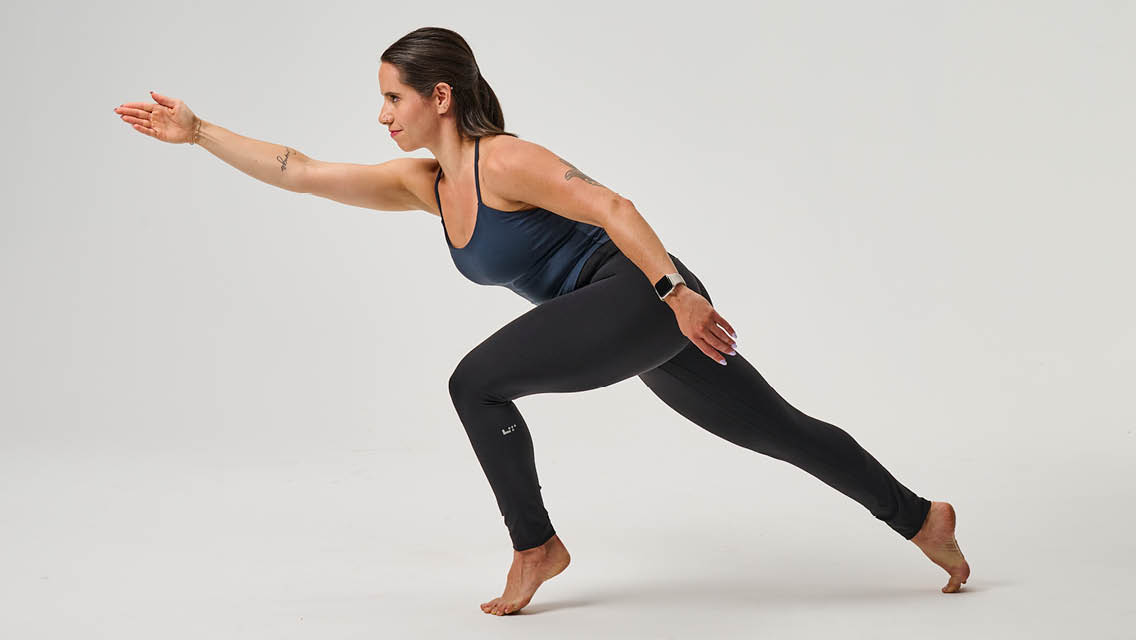
4. Traveling Lunge and Reach
What to watch out for: holding breath, looking to the floor, caving the front knee inward as balance shifts.
Perform 20 lunging steps. Repeat on the opposite side.
- Step one foot forward into a lunge and extend the opposite hand out in front of you. Reach with your eyes first and let the fingers follow to help pull you farther forward.
- The body will begin to twist through the spine to follow; let it. That rotation is the reach finding more range by unwinding from the back foot all the way through the hips, the rib cage, and out through the fingertips. Breathe through it.
- Step your back foot forward to meet the front foot. Repeat on the opposite side. Take 20 lunging steps forward.
5. Foot Reach — Backward Lean
What to watch out for: holding breath, dropping eyes, bending at the waist instead of leaning from the ankle.
Find your edge. Breathe and reach for as long as you are able. Repeat on the opposite side.
- Stand tall with your weight on one foot. Extend the other foot forward, reaching as though your toes are fingers. Lean backward, allowing the counterbalance to happen.
- Let the first reach happen between the extended toes and the knee, then through the knee and the hip and upward through that chain. Keep your eyes focused on where your toes are reaching.
- Breathe and reach until the standing foot is on its toes now, with the reaching foot extended forward and the whole body forming a long line between toes and head.
- Find the edge where the lean is real and the length is maintained. Breathe and reach for as long as you are able.



Comments (0)