



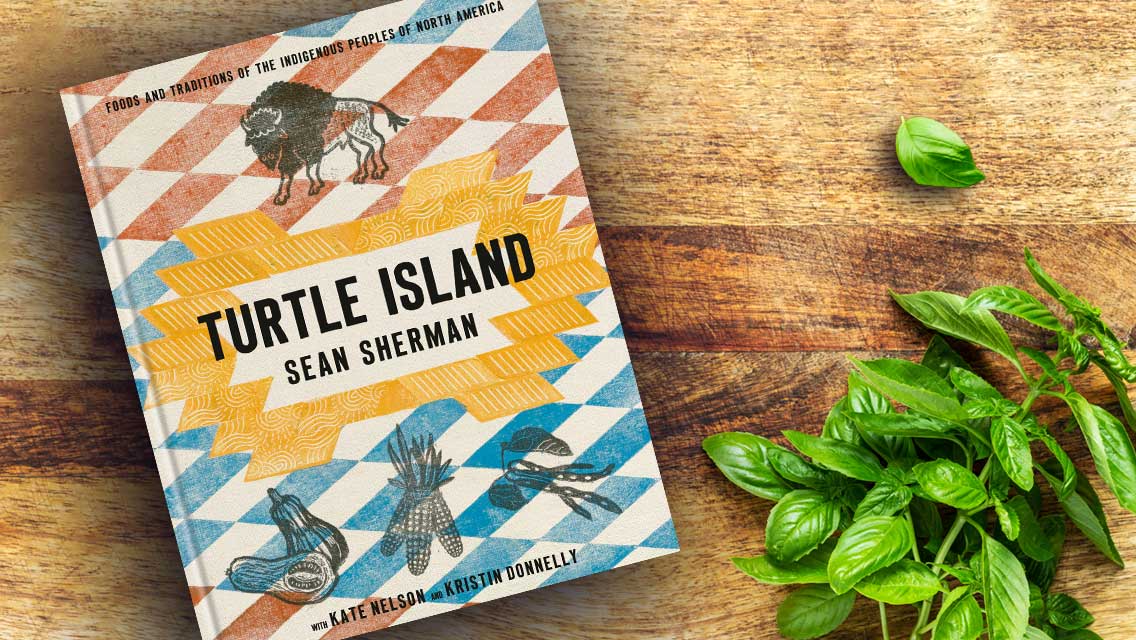
Explore this Article
Many cultures have mythology about the world being created on the back of an ancient turtle, like the Haudenosaunee (Iroquois) creation stories. The term “Turtle Island” represents a world where humans live in harmony with nature. This understanding shifts how we perceive the land, moving away from arbitrary colonial borders and recognizing the vast interconnectedness of our countless Indigenous communities across what is now the United States, Mexico, and Canada.
The concept of Turtle Island transcends mere geography; it embodies a worldview that emphasizes balance, respect, and unity. The Haudenosaunee creation story tells of Sky Woman falling from the sky world, landing on a giant turtle’s back, and creating the Earth with soil brought up by animals from the water below.
This narrative symbolizes a deep reverence for the Earth, which is seen as a living entity deserving of care and respect. This perspective influences Indigenous foodways, where sustainable practices and seasonal cycles are integral to the cultivation, harvest, and preparation of food.
Traditional foodways are innately tied to our identities as Indigenous peoples. The meals we prepare nourish not just our bodies but also our spirits and our connections to our heritage. In Native cultures, food practices are imbued with stories of creation, determination, and survival. They express joy and sorrow that connect us to our legacies.
The modern Indigenous culinary movement is not about nostalgia for a past that can never be fully reclaimed. It’s about stepping into the future, holding the hands of our ancestors, and creating a vibrant, living culture that honors the past while innovating for future generations.
By exploring and embracing Native foodways, we can all participate in a broader movement toward food sovereignty, cultural respect, and environmental stewardship. Let us savor each bite as a step toward healing, connection, and understanding — a tribute to the enduring spirit of what we call Turtle Island.
Summer Succotash
Succotash is often described as an early colonial dish, but when you look at the major ingredients — corn and beans — it’s clear that its origin is Indigenous. The name succotash is thought to come from the Wampanoag word “misckquatash,” meaning “corn and beans together.” Today, this dish is far more popular in the South.
There are endless recipes for succotash, and the dish can be adapted for the seasons. For example, during certain times of year, you might use cooked dried corn instead of sweet corn and cooked dried beans instead of fresh.
This recipe celebrates peak summer, when you can find sweet corn, green beans, fresh tomatoes, and a gift from Africa that has found another home in the South: okra.
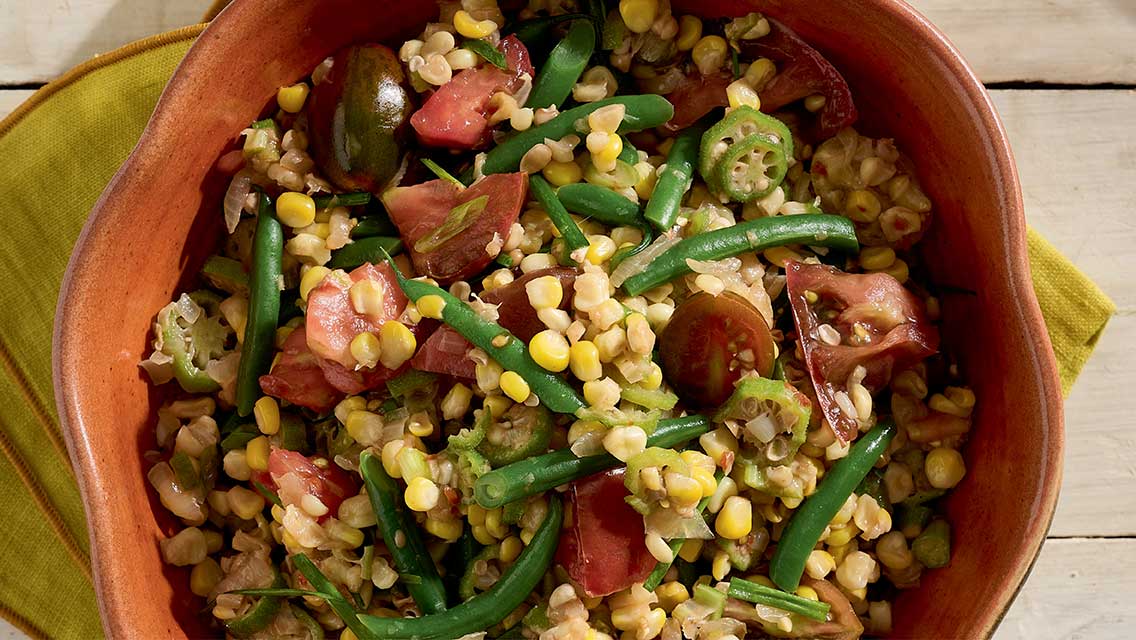
Makes 4 servings • Prep time 15 minutes • Cook time 20 minutes
- 2 tbs. sunflower oil
- 1 small onion, finely chopped
- Sea salt
- 2 garlic cloves, thinly sliced
- ½ red fish pepper or other hot red chili (optional), seeded if desired and minced
- Kernels from 2 ears sweet corn
- 8 oz. fresh Cherokee Trail of Tears beans or other green beans, halved crosswise
- 8 oz. okra, cut crosswise into rings
- 1 large Cherokee Purple tomato or other heirloom variety, cored and cut into ½-inch pieces
- 2 tbs. finely sliced wild onion greens or chives
- Ground sumac
- In a skillet, heat the oil over medium heat.
- Add the onion, season with salt, and cook for about five minutes, or until softened.
- Add the garlic and chili (if using) and cook for about two minutes, or until softened.
- Add the corn kernels and cook for four minutes, or until starting to brown.
- Add the beans, a pinch of salt, and ½ cup water, and cook for two to three minutes, stirring, until the water has evaporated and the beans are crisp-tender.
- Add the okra and cook for two to three minutes, stirring, until just tender.
- Turn off the heat and stir in the tomato and onion greens.
- Taste and season with salt and sumac as needed.
Maple-Glazed Salmon
Salmon is a sacred food for Indigenous peoples in the Columbia Plateau, just as it is for people near the coast. Bigleaf maple trees grow not too much farther west of the Plateau. Syrup from this western maple is deep in flavor with molasses-like notes. If you can find it, use it in this glaze, which is enlivened with vinegar and sumac, but any maple syrup works well.
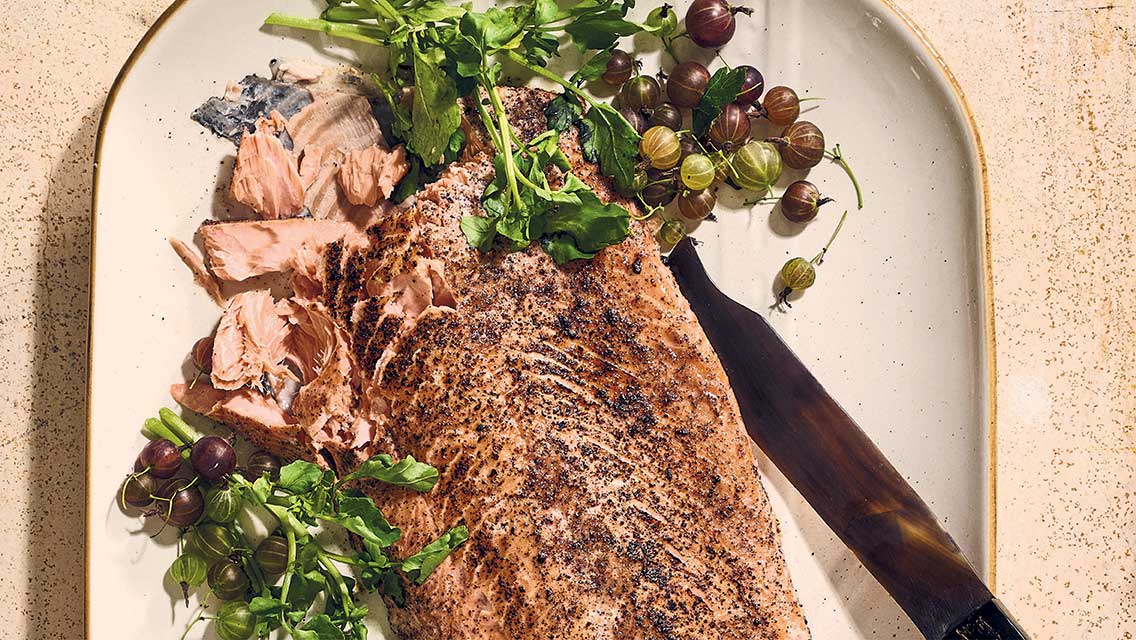
Makes 4 servings • Prep time 5 minutes • Cook time 15 minutes
- 1 skin-on wild salmon fillet (1½ lb.)
- ¼ cup maple syrup
- 2 tsp. apple-cider vinegar
- 2 tsp. sunflower oil
- 1 tsp. ground sumac
- ½ tsp. onion powder
- Sea salt
- Preheat the oven to 375 degrees F.
- Line a sheet pan with parchment paper or, if you’d like a more richly browned salmon, line the pan with foil so you can finish it under the broiler.
- Place the salmon on the pan skin-side down. Feel for any remaining pin bones and use tweezers to extract them, as needed.
- In a small bowl, whisk together the maple syrup, vinegar, oil, sumac, and onion powder. Use this glaze to brush the fish, then season well with salt.
- Bake for five minutes, then brush again with the glaze. Continue baking for about five minutes longer, or until a thermometer inserted into the thickest part registers 145 degrees F, depending on the thickness of the fillet. If the fish was previously frozen, you can cook it slightly less if you prefer salmon cooked to medium.
- If you’d like a bit more caramelization, broil the fish on high heat for one to three minutes.
- Let the fish rest for a few minutes, then cut into portions and serve.
Roasted Smashed Baby Potatoes With Wild-Greens Pesto
In parts of the Southwest, there’s a variety of wild potato (Solanum jamesii) known as the Four Corners potato. Some Indigenous peoples in the region have long gathered or cultivated the tiny tuber, while others are reintroducing this traditional food to their gardens and diets today.
Unlike the common potato (Solanum tuberosum), the Four Corners potato is frost and drought tolerant — perfect for the cold high-desert climate of the region. They are harvested when they are small (from about the size of marbles up to 1 inch large). While packed with nutrients, they can also have a significant amount of glycoalkaloids. These naturally occurring plant compounds help protect a plant from pests and are found in most nightshades, including tomatoes, peppers, and potatoes. While generally harmless to humans at low levels, too much of them can cause gastrointestinal upset or other adverse symptoms.
At this moment, it’s challenging to find Four Corners potatoes commercially or even to grow them. If you’re lucky enough to gather some, treat them like any other wild food and eat a small amount first before consuming more. If a tuber is especially sour or bitter, it’s best not to eat it.
Perhaps, over time, this variety will become more domesticated — with more consistently lower glycoalkaloid levels — and a popular regional food plant. Inspired by this Indigenous potato, though, I created this recipe, which features crisp-edged potatoes flavored with a pesto of garlic, piñon pine nuts, and wild greens. Use the smallest potatoes you can find.
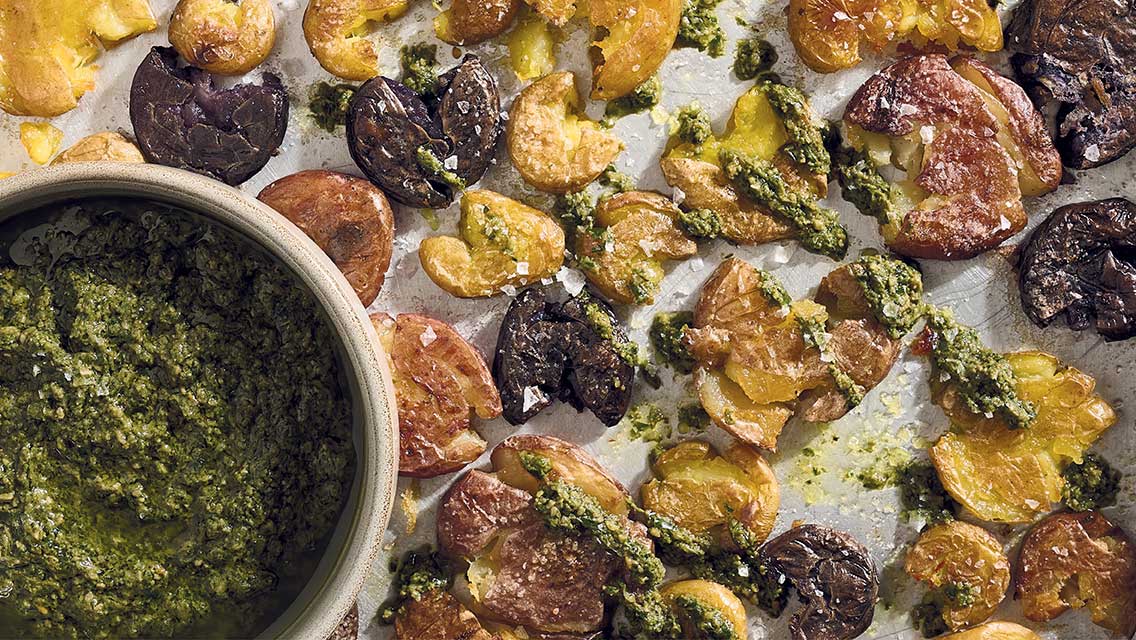
Makes 4 servings • Prep time 5 minutes • Cook time 60 minutes
- 1½ lb. Four Corners potatoes or baby potatoes, scrubbed well
- Sea salt
- Sunflower oil, for the pan and drizzling
Wild Greens Pesto
- 2 tbs. piñon pine nuts or other pine nuts
- 2 cups packed wild greens, such as lamb’s quarters, common plantain, watercress, or wild mustard
- 1 bulb and greens from wild garlic or 1 small garlic clove
- ½ cup sunflower oil
- Sea salt
- 1 tbs. apple-cider vinegar
- Preheat the oven to 450 degrees F.
- In a large saucepan, combine the potatoes with water to cover by 1 inch, and season with salt. Bring to a boil over high heat, then reduce the heat to medium-low and cook for 10 to 20 minutes, just until fork-tender.
- Drain the potatoes and return them to the pot. Set them over low heat for a minute or two, just to dry them.
- Grease a sheet pan with oil and set it in the oven for one minute. Pull it out just long enough to add the cooked potatoes and lightly crush each one using the bottom of a mug. Drizzle them with oil and season with salt.
- Roast for 15 to 30 minutes, until the potatoes are golden brown and crisp at the edges.
- Meanwhile, make the pesto: In a small dry skillet, toast the pine nuts over medium heat for about two minutes, or until golden with a few browned spots. Transfer to a food processor to cool.
- Add the greens and garlic to the processor and pulse to chop. With the machine running, add the oil until incorporated and the pesto is finely chopped. Season with salt. Transfer to a bowl. Just before serving, stir the vinegar into the pesto. Serve the potatoes with the pesto.







Comments (0)