



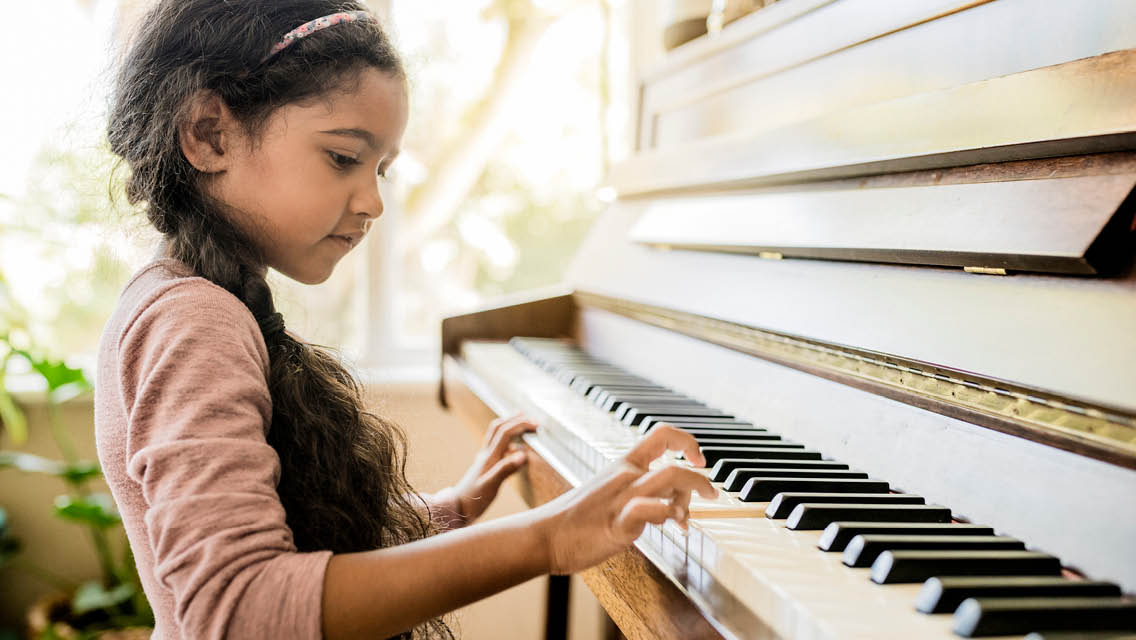
The computer boom of the past 30 years sparked a surprising side effect — parenting advice. Teach your children coding, experts recommended: Even preschoolers will benefit, in daily problem-solving and computational thinking, as well as in their future careers.
Recent research, though, suggests that if you want smarter kids, teaching them music is important.
This advice may sound like an old song, but a 2021 study published in the Journal of Neuroscience zeroes in on how music shapes functional and structural brain networks.
Stanford and University of Zurich researchers recruited 103 student, amateur, and professional musicians and 50 nonmusicians, with nearly even numbers of females and males, and with a median age of 25. The musicians had begun instruction between ages 4 and 9 and trained for 13 to 25 years.
Comparing brain scans of musicians and nonmusicians conducted with fMRI and diffusion-weighted imaging, scientists found that musical brains had more robust structural and functional connections between and within brain hemispheres.
“Our results suggest that long-term musical training is associated with robust changes in large-scale brain networks,” the researchers write. Learning music early in life makes the brain more inter- and intraconnected by stimulating neural plasticity.
An earlier study published in the same journal measured greater gray-matter volume in the motor, auditory, and visual–spatial brain regions of professional musicians compared with amateurs and nonmusicians.
A metareview of studies published in Frontiers in Neuroscience similarly found that musically trained children displayed better reading ability, verbal memory, second-language pronunciation accuracy, and executive function. The researchers attribute this to the focus such training requires — particularly the study of timing and rhythm.
This article originally appeared as “The Case for Teaching Music to Kids” in the September 2022 issue of Experience Life.







Comments (0)