



Many of us (by which I mean me) start each morning feeling as if we’re in a kind of productivity debt, one we must struggle to pay off throughout the day in hopes of a zero balance by the time evening comes.
Few things feel more basic to my experience of adulthood than this vague sense that I’m falling behind and need to claw my way back up to some minimum standard of output. It’s as if staying on top of things will not only justify my existence but also stave off some ill-defined catastrophe.
This feeling of indebtedness doesn’t just apply to work tasks. In times like these, it’s equally easy to feel in debt when it comes to political activism, donations, and community service. Not to mention trying to be a good-enough partner, parent, and friend. There’s just so much that needs doing. So, naturally, one really has to buckle down to have any hope of getting to feel like a decent person.
I recently suggested on social media (again, a suggestion directed mainly at myself) the idea of trying another perspective: What if you began each day at a zero balance, so that everything you accomplished — every task you got done, every tiny thing you did to address the world’s troubles or the needs of your household — put you into the black?
What if (and, personally, I find this thought almost unthinkable in its radicalism, but here goes) there’s nothing you ever had to do to earn your spot on the planet? What if everything you do get around to doing, on any given day, is surplus to the minimum requirements?
There’s an obvious objection here. To achieve certain outcomes, there are things we have to do. To get you this column, I had to write it. To have a clean kitchen, I have to clean the kitchen, or else passive-aggressively comment on its disastrousness until my partner cleans it. To pay the mortgage, I have to generate an income. This is where inequality enters the picture, too, because of course some of us have to do a lot more than others to stay afloat.
Yet many of us overlay this instrumental obligation with an existential one: The feeling that we must get things done not merely to achieve certain ends but because it’s a cosmic duty we’ve somehow incurred in exchange for being alive.
Write It Down
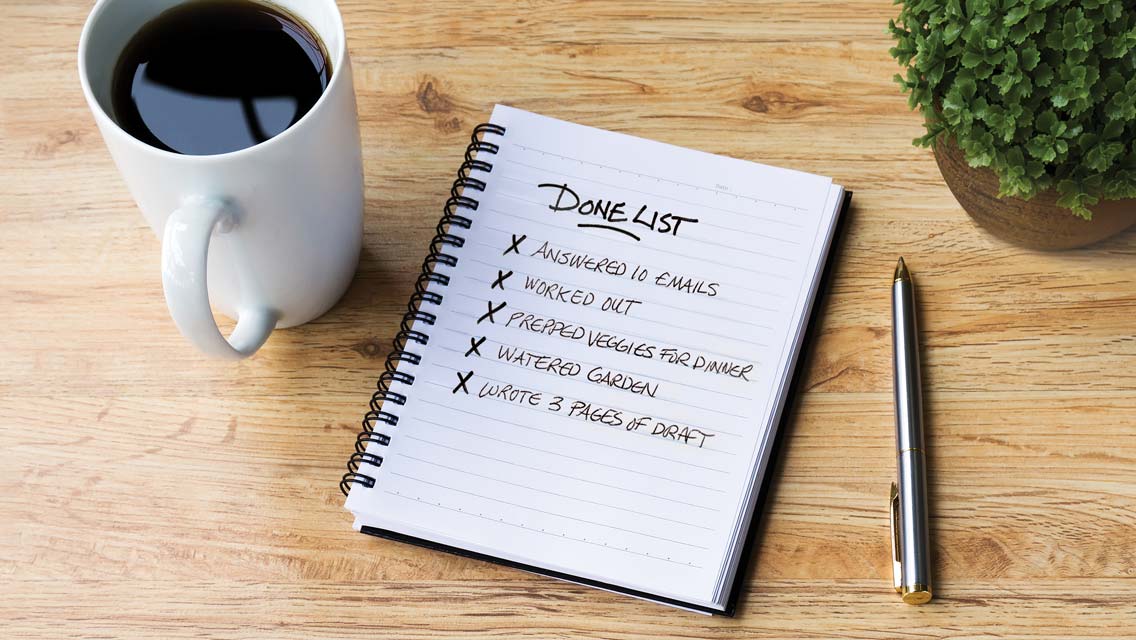
This is why I’m such an enthusiastic proponent of keeping a “done list.” It starts empty in the morning and then gets filled with whatever you accomplish throughout the day. Each entry is a cheering reminder that you could have spent the day doing nothing — yet look what you did instead! (If you’re in a serious psychological rut, just lower the bar for what counts as an accomplishment; nobody else needs to know that you added “brushed teeth” or “made coffee” to the list.)
A done list isn’t merely a way to feel better about yourself. Giving up the impossible quest to pay off your productivity debt and thinking of each day as a chance to move a small-but-meaningful set of items to the done list allows you to make better choices about what to focus on. And you’ll make more progress on them, too, because you’ll waste less time and energy being stressed about the stuff you’re unavoidably neglecting.
What’s more, paying off your imaginary productivity debt (in other words, working so hard and so efficiently that you no longer feel like you’re falling behind) is not just grueling and unpleasant, it’s literally impossible. In the modern world of work, there’s no limit to the number of emails you might receive, the demands your boss might make, or the ambitions you might have for your career. So there’s no reason to believe you’ll ever get to the end of them.
Whenever I manage to remember that the cosmic debt I imagine I must pay off is, in fact, unpayoffable, I find I’m far better able to relax in the midst of having too much to do — as opposed to making relaxation dependent on getting on top of it all, which I never will.
I’m also far better placed to actually do things, both the productive things and the good-citizen things, that were the focus of all my angst in the first place. Look! There they are, on the done list! Not many of them, perhaps, at least by comparison to the immeasurable galaxy of things that need doing, but there are generally quite a few by the time 6 p.m. rolls around.
At which point I usually mix a gin and tonic, though I tend not to add that to the list.








Comments (0)