




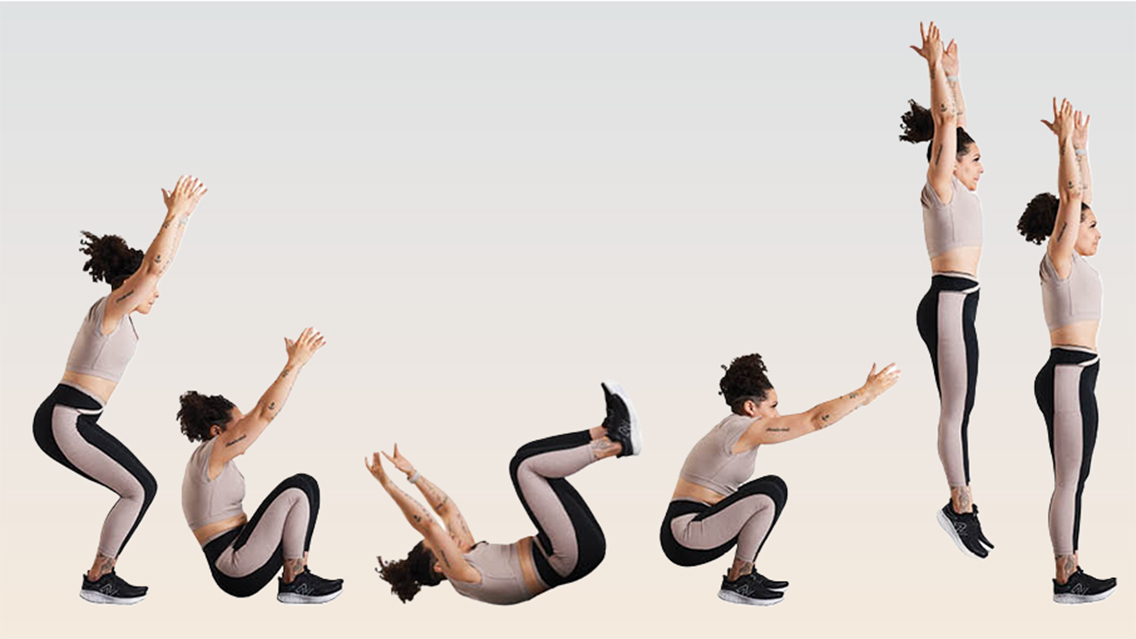
Burpees — that grueling combination of squats, pushups, and jumps — are not only a physical challenge but a mental one. Typically associated with high-intensity workouts and gym-class punishment, they’re an easy exercise to hate and avoid.
But at their heart, burpees are a test of one’s ability to get down on the ground and back up again. Seen in this light, burpees are actually a form of survival training, especially as we get older.
“You get down, you get up — that’s all the burpee is,” says Life Time personal trainer and group fitness coach Jen Walter. She coaches the movement in her Hybrid XT classes, which prepare athletes of all ages for hybrid endurance events, as well as in her ARORA groups, which are tailored to exercisers 55 and older. “If you don’t practice, at some point you’re going to get down on the floor and you’re not going to be able to get back up. The burpee is one way to retain that ability.”
For many people, the loss of physical mobility happens gradually, says Walter.
“It can start with avoiding an exercise because it’s too hard, or [it] feels uncomfortable, or it’s inconvenient, or you have an injury, or you just don’t like it,” she says. “So you stop doing that exercise, but you also stop doing that movement pattern.”
For example, say you get plantar fasciitis and to avoid pain you stop going for daily walks. Or you experience a bout of frozen shoulder — stiffness and pain commonly associated with menopause — and never resume reaching overhead to avoid aggravating the joint. Perhaps you stop sitting on the floor simply because there are more comfortable and convenient places to sit.
“There are so many movements that you could do but stopped doing for whatever reason, and then one day you simply can’t. That’s frightening,” says Walter. “The question then becomes, Can you get it back?”
Yes, you can, she says. “Generally speaking, as long as your joints are mechanically functional, it’s not too late to try.”
If you’re ready to give burpees another go (or to try them for the first time), begin with this two-pronged approach.
1. Get your brain on board.
Toy around with the idea that burpees are functional and beneficial for healthy aging. Remind yourself that they are a way to practice getting down on and up off the floor, a useful skill whether you’re playing with your grandchildren or getting up after a fall.
Consider that the underlying skill of burpees also exists with different names across different cultures. Take yoga, for instance: The surya namaskar sun salutation sequence takes practitioners from standing to a prone lying position and back to standing.
If it helps, rename the burpee to better suit you; something as simple as “up-downs” could shift your mindset.
2. Break the burpee down. Way down.
You may assume that you have to do a perfect squat, a perfect pushup, and a series of fast-paced jumps to do a burpee. Forget those rules, says Walter. “Start by figuring out how you can get your belly to the ground safely.”
Using your hands — and a nearby sturdy support, such as a chair or wall, as needed — step one foot back as if you’re going to do a reverse lunge, drop that knee, and get down on all fours. Then, moving one knee back at a time, lower yourself all the way down so your hips and chest are flat on the floor. Reverse the movement by pulling your knees back up.
“Getting your knees under your hips with control on the way down and up is really the key here. Don’t rush the quadruped position,” Walter says. Then, bring one foot up at a time to replace your hands on the floor and push yourself up to a standing position. Finally, reach your arms overhead as far as you comfortably can. Add a little jump here, if you want. Then repeat.
Do five slow and controlled burpees in this manner when you wake up in the morning or as part of your warm-up routine at the gym — anything that helps make them consistent.
“Safe and repeatable is the goal,” Walter says. “It’s deconstructed, but it works.”
This article originally appeared as “Reimagining Burpees” in the July/August 2026 issue of Experience Life.


Comments (1)
A video or even photos showing the modifications would be helpful :)