



In 1854, pioneer nature-lover J. Sterling Morton moved to the Nebraska Territory with his wife, where they planted trees, flowers, and shrubs. Morton used his platform as a journalist to spread news about agriculture information, and advocated for tree planting by individuals and organizations, according to ArborDay.org.
In 1872 he proposed “Arbor Day” as a tree-planting holiday at a State Board of Agriculture meeting, and around one million trees were planted in Nebraska on the first Arbor Day. By 1882, it became an annual tradition in schools across the country, usually being celebrated on the last Friday in April.
Trees were needed in Nebraska in the 1800s for soil and wind protection as people farmed, and raised their families on the land. They are just as important today — whether you live in the city and country.
Here is a recent example of a modern threat to trees — and how citizens like you stood up to protect the environment. We hope you’re as inspired by this story as the team here at Experience Life. Happy Arbor Day 2014!
Duke Energy suspends pilot program aimed at limiting tree growth as a result of public outcry
Think your voice can’t be heard? Think again. In three North Carolina cities, a pilot program by Duke Energy that aimed to limit the growth of trees so they wouldn’t extend into overhead power lines was put on hold earlier this month due to citizen concerns.
But not before initial efforts began, despite lingering questions about safety.
“About 300 trees on private and public lands were treated before the effort was halted,” Duke Energy spokeswoman Paige Layne told Charlotte Observer writer Fred Clasen-Kelly for a recent article. By “treated,” Layne refers to the injection of the chemical Cambistat into tree’s root systems, which would alter the tree’s hormones and slow growth by 40 to 70 percent over the course of three or more years.
While the Charlotte-based gas and electric company, along with Minnesota-based Rainbow Treecare, maintained that the toxicity levels of Cambistat were low, residents remained unconvinced. And many were deservedly upset when they found workers in their yard inspecting and injecting the chemical without providing adequate information about the program or the chemical.
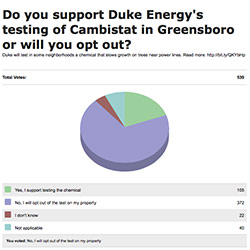
One resident said she was told the injection would also slow the growth of nearby plants, and that she should keep children and dogs away from the trees as a precaution.
Property owners had the opportunity to request that Cambistat and other herbicides not be used on their property by submitting a refusal form and posting “no spray” signs in their lawns. Yet residents say they weren’t given enough time to choose the opt-opt option.
Reaction to the program came in response to Clasen-Kelly’s article about the program and resident complaints — and concerns “grew louder” via social media. Duke Energy pulled the program a few days later, saying they failed to “adequately forewarn customers and inform them about why it planned to evaluate the use of Cambistat.”
“We want to figure it out,” Duke Energy spokesman Layne told Clasen-Kelly.
In the meantime, many residents, like Mary Lou Buck, a board member of the Freedom Park Neighborhood Association in Charlotte, are relieved the program has been suspended. “There were answers to some questions, but there were not answers to all of them.”
The program was scheduled to launch later this spring in Greensboro, Charlotte, and Durham. Around 20 trees species in the North Carolina cities were supposed to be “treated,” including elms, sweet gums, maples, and oaks.


Comments (0)