



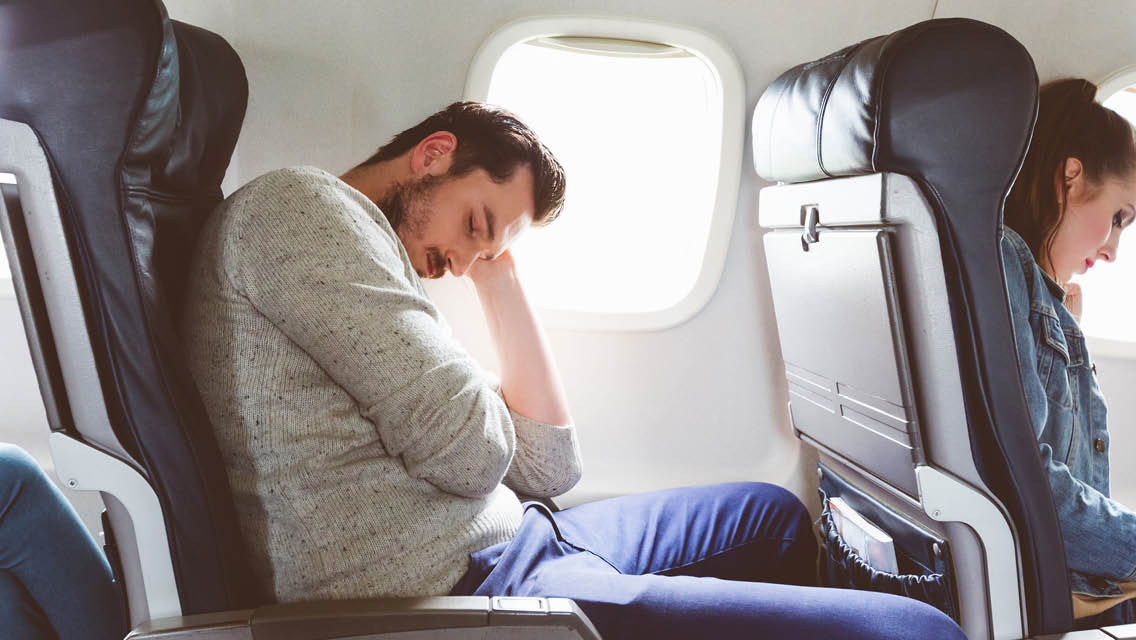
Anyone who has endured a restless night before an early flight knows that travel can affect sleep even before you leave home. Add in changing time zones, stress, and unfamiliar environments, and the challenges to sleep only mount.
When traveling across time zones, Sara Jean Barrett, ND says, try to adapt as quickly as possible to the clock time at your destination. “Eat meals aligned with where you are,” she suggests. “If it’s morning when you land, have breakfast.” And make sure to expose yourself to morning sunlight, one of the best tools for adjusting your internal clock.
Keep your last meal of the day lighter, and eat earlier. “If your body is digesting food at night, you won’t sleep as well,” says integrative psychiatrist Henry Emmons, MD, author of The Chemistry of Joy.
Nutritionist Samantha McKinney, RD, CPT, a Life Time master trainer adds that including a small amount (about a cupped handful) of carbs with a protein-rich dinner can support serotonin and melatonin production. Adding some sweet potato or quinoa to a meal “can be helpful to support overall sleepiness,” she says.
Taking 1 to 3 milligrams of melatonin about 30 minutes before bed can help reset your circadian rhythm. (Higher doses aren’t more effective, says Barrett; they just cause a hangover effect the next day.)
“If you’re traveling across many time zones, use melatonin for several nights, not just the first,” she suggests. Chewable tablets work, or try sublingual melatonin, which is absorbed even more quickly.
A tincture of passionflower or a mixture of the cannabinoids CBD (cannabidiol) and CBN (cannabinol) may calm a busy mind at bedtime. Sleep-promoting tea packets containing valerian root, chamomile, hops, or passionflower are easy to throw in your bag and prepare in a hotel room.
Remember that even when you’re traveling within the same time zone, altered routines and environments can present challenges. “The circadian rhythm is tied to when we exercise and eat food each day,” notes McKinney. “When that routine is shifted from our usual schedule, it can be disruptive to sleep.”
This was excerpted from “6 Common Travel Illnesses and How to Treat Them” which was published in the November 2022 issue of Experience Life.





Comments (0)